

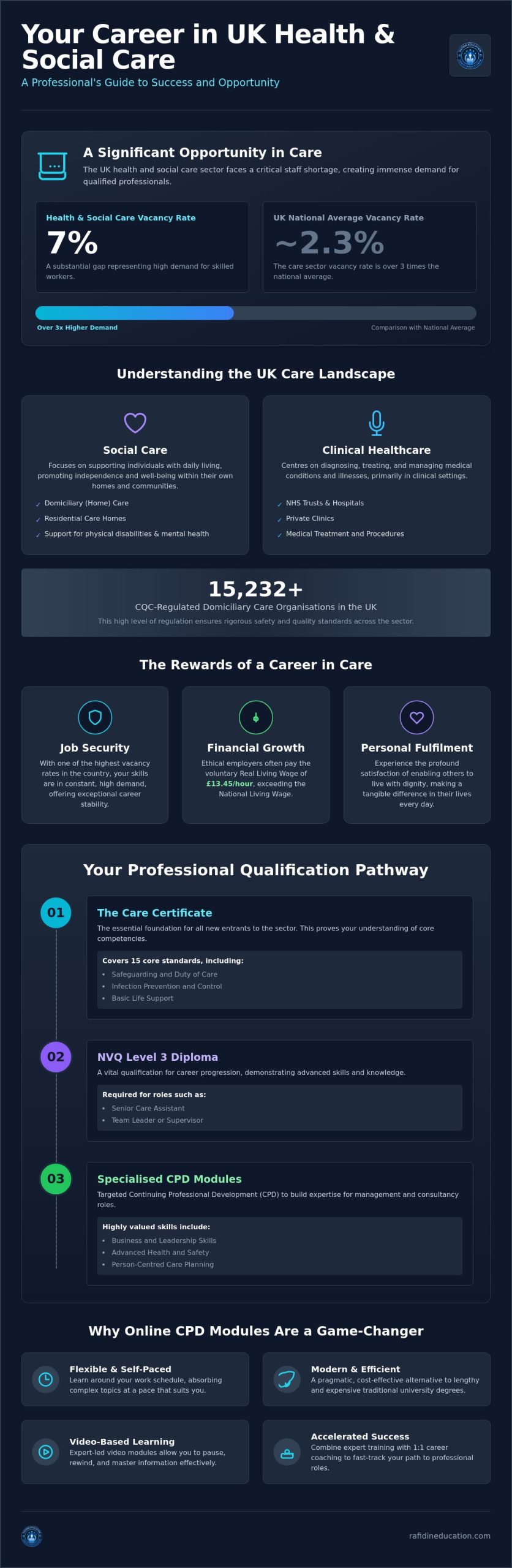
Did you know that the vacancy rate in the UK’s health and social care sector is currently 7 per cent, which is more than three times the national average? This staggering gap represents a massive opportunity for you, yet you might feel stuck behind a wall of complex regulations and confusing qualification requirements. It’s exhausting to search for answers only to find generic advice that doesn’t account for your unique background or the specific demands of the British market. You want a career that offers stability and purpose, but the path forward often feels obscured by administrative hurdles and a lack of clear mentorship.
You deserve a professional strategy that transforms your uncertainty into absolute confidence. This guide promises to demystify the entire process, offering expert insights on how to build a standout career. We’ll explore the power of CPD-accredited training, identify the essential qualifications employers actually value, and explain how personalised career coaching can fast-track your success. From understanding the latest CQC regulations to securing a role that pays the Real Living Wage of £13.45 per hour, you’re about to gain the tools needed to lead with excellence in your field.
Key Takeaways
- Understand the vital distinction between clinical healthcare and community-based support to find your ideal professional fit.
- Identify the essential CPD-accredited certificates required to secure a professional role in the UK health and social care sector.
- Master the principles of person-centred care to ensure you deliver support that upholds dignity, choice, and independence.
- Learn how to structure a professional UK-style CV that effectively highlights your training and secures interviews with top providers.
- Discover how combining expert-led video modules with 1:1 career coaching can accelerate your path to professional success.
What is Health and Social Care in the UK?
The UK care sector is much more than a collection of jobs; it’s the foundation of a compassionate society. When people ask, What is Health and Social Care?, they often imagine hospitals and doctors first. While clinical healthcare focuses on treating medical conditions in settings like NHS trusts or private clinics, social care provides the essential bridge to independence. It supports individuals with physical disabilities, mental health challenges, or age-related needs within their own homes and local communities. Health and social care is a multi-disciplinary field that requires a rare combination of technical skill and deep empathy.
The Scope of the British Care Sector
The landscape of care in the UK is vast and highly regulated. You’ll find professionals working in domiciliary care, where they support people in their own houses, or in residential care homes that provide 24-hour assistance. Currently, there are over 15,232 CQC-regulated domiciliary care organisations across the country. This oversight by the Care Quality Commission (CQC) ensures that every provider meets rigorous safety and quality standards. Because of these high expectations, the UK market prioritises candidates who hold accredited certifications. Employers aren’t just looking for staff; they’re looking for professionals who understand the legal and ethical framework of the British system.
Why Pursue a Career in this Field?
Choosing this path offers a level of job security that few other industries can match. With a vacancy rate of 7 per cent in England’s adult social care sector, your skills will always be in high demand. This isn’t just about finding a job; it’s about building a career with a clear trajectory. You can start in an entry-level support role and progress into management, training, or specialised consultancy. Success here is limited only by your willingness to learn and grow.
The rewards are both financial and emotional. As of April 2026, the National Living Wage is £12.71 per hour, but many ethical employers now pay the voluntary Real Living Wage of £13.45 to attract top talent. Beyond the paycheck, you’ll experience the profound satisfaction of enabling someone to live with dignity. Every day presents a new opportunity to change a life. This makes it one of the most fulfilling professions you can choose, providing a sense of purpose that stays with you long after your shift ends.
Essential Qualifications and the Power of CPD Accreditation
UK employers in the health and social care sector prioritise one thing above all else: validated competence. While experience is valuable, professional accreditation proves you understand the legal frameworks and safety protocols required to protect vulnerable individuals. This is where Continuing Professional Development (CPD) becomes your greatest asset. CPD isn’t just a box-ticking exercise; it’s a structured approach to lifelong learning that ensures your skills remain sharp and compliant with the latest government standards. By choosing CPD-accredited modules, you signal to hiring managers that you’re a committed professional who takes the quality of care seriously.
The Care Certificate and Beyond
If you’re just starting out, the Care Certificate is your essential baseline. It consists of 15 standards, covering everything from safeguarding and mental health to basic life support and infection control. This certificate is the industry’s way of ensuring every worker has the same high-quality foundation. Once you’ve mastered these basics, the path to seniority often involves progressing to NVQ Level 3. This qualification is vital if you’re aiming for team leader or senior support roles. If you’re researching Careers in the Department of Health & Social Care, you’ll quickly notice that specialized modules in business skills and health and safety are highly prized for management-level positions.
Why Online CPD Modules are a Game-Changer
Traditional university degrees are often expensive and time-consuming, taking years to complete. Online CPD modules offer a modern, efficient alternative that fits around your life. Video-based learning allows you to absorb complex information at your own pace, pausing and re-watching sections until you feel completely confident. This flexibility is crucial whilst you’re already working in the field, as it allows for the immediate application of new techniques in your daily shift. It’s a pragmatic way to build your portfolio without the financial burden of traditional tuition.
Accreditation ensures your training meets the rigorous standards set by British regulatory bodies. Employers trust these certificates because they know the content is current and peer-reviewed. If you’re ready to take that first step toward compliance and professional recognition, exploring CPD-accredited courses is the most strategic move you can make. It transforms your CV from a simple list of jobs into a record of professional excellence. Don’t leave your career progression to chance when you can secure the qualifications that top-tier providers are actively searching for today.
Mastering the Principles of Person-Centred Care
Person-centred care isn’t just a buzzword; it’s the absolute gold standard of the UK health and social care system. It represents a fundamental shift from “doing things for people” to “working with people.” This philosophy ensures that every action you take respects the dignity, choice, and independence of the individual. The Department of Health and Social Care (DHSC) champions this approach because it leads to better outcomes and higher satisfaction for those receiving support. You aren’t just a service provider; you’re a facilitator of a better life.
Finding the right balance between professional boundaries and warm empathy is a skill you’ll develop over time. You must remain a supportive mentor without losing the objectivity required for safety and reporting. Person-centred care ensures that the individual remains the architect of their own support plan, not just a recipient of a service. This empowerment is what separates a standard carer from a truly exceptional professional. When you place the individual at the heart of your practice, you transform a routine task into a meaningful interaction.
Communication and Safeguarding
Mastering effective communication is vital when supporting diverse and vulnerable populations. You’ll often need to adapt your style to suit individuals with cognitive impairments, speech difficulties, or sensory losses. Beyond talking, you have a legal and ethical duty of safeguarding. This means you must be vigilant in protecting individuals from harm, neglect, or exploitation. Recognising the subtle signs of abuse is a core competency that every employer demands. The UK has a strong whistleblowing culture; you’re expected to speak up if you see something that isn’t right. It’s about being the person who ensures safety when others cannot.
Health and Safety in a Care Environment
Your workplace might be a clinical ward or someone’s private living room. Regardless of the setting, you must maintain impeccable clinical hygiene standards to prevent infection. Infection control remains a pillar of CQC inspections, requiring constant attention to detail. You’ll learn to conduct basic risk assessments to identify hazards before they cause injury. This proactive mindset protects both the carer and the individual receiving support. Safety isn’t an accident; it’s the result of rigorous training and constant awareness. When you master these technical skills, you create a secure space where person-centred care can truly flourish.
Navigating the UK Job Market: Strategy and Consultancy
How do I actually get hired in the UK? This is the most common hurdle for talented professionals looking to enter the health and social care sector. The British job market is highly competitive, and simply applying to online portals isn’t enough to stand out. You need a strategic approach that combines technical qualifications with a deep understanding of local hiring practices. Success requires more than just a list of past roles; it requires a professional narrative that proves you’re ready for the specific challenges of the UK care environment.
Crafting Your Professional Narrative
Your CV is your first impression. UK recruiters often spend only a few seconds scanning a document, so it must be clear and impactful. If you have international experience, you must translate those skills into terms British employers recognise immediately. Focus on your competency-based results and highlight your CPD-accredited modules as proof of your commitment to UK standards. Showing that you’ve already invested in local compliance makes you a low-risk, high-value candidate. When you reach the interview stage, be prepared for competency-based questions. Practice describing specific scenarios where you’ve demonstrated leadership or empathy, as this is the standard expectation across the healthcare sector.
The Value of Expert Job Consultancy
Why struggle through the process alone when you can have a strategic partner in your corner? Navigating the complexities of the UK employment market is much easier with professional guidance. A specialist consultant acts as the missing link between your training and your first professional role. They help you bypass the “experience gap” by showing employers exactly how your transferable skills map to their specific needs. Expert consultancy also provides vital insights into which providers offer the best growth prospects and sponsorship opportunities. Having a mentor to guide you through this transition transforms a stressful search into a structured journey toward a secure career.
Once you secure your role, your professional conduct will define your long-term success. British workplace culture places a high premium on punctuality, reliability, and proactive teamwork. You aren’t just there to perform tasks; you’re there to contribute to a culture of excellence. Embracing these values from day one will help you integrate quickly and build a reputation as a trusted professional. If you’re ready to stop guessing and start applying with confidence, take control of your future by accessing our UK job consultancy services today. This is the moment to turn your aspirations into a tangible professional reality.
Accelerating Your Career with RAFIDIN Education
Stop searching for fragmented advice and start building a structured future. RAFIDIN Education provides a comprehensive ecosystem designed specifically for your professional transformation. We understand that certificates alone aren’t enough to guarantee success in a competitive market. That’s why we’ve combined rigorous CPD-accredited training with the practical agility of 1:1 coaching. This dual approach ensures you don’t just learn the theory; you master the application. You’re joining a community of like-minded professionals who value excellence and mutual support, making your career journey a shared success story.
Our platform acts as a launchpad for your ambitions, removing the uncertainty that often stalls progress. We’ve replaced dry, academic lectures with engaging, video-based learning that you can access at your own convenience. This flexibility is essential for those balancing current work commitments with the desire to move into a more specialised role. By the time you complete your training, you’ll have a portfolio that proves your readiness to lead and care at the highest British standards.
Professional Training Tailored for You
Finding the right training shouldn’t be a chore. We offer a diverse range of courses designed to meet the exact requirements of the UK health and social care sector. Whether you’re an individual looking to break into the field or a company seeking to elevate your workforce, our modules provide the clarity you need. We cover essential topics in care delivery, workplace safety, and core business skills for aspiring managers. This ensures you’re prepared for the daily realities of the job, from clinical hygiene to complex safeguarding. Explore our Health and Social Care courses to find the programme that matches your specific career goals.
Personalised 1:1 Coaching with Mirela Anghelache
Knowledge is a powerful foundation, but confidence is the key that unlocks the door to your ideal role. This is where the mentorship of Mirela Anghelache becomes your most valuable asset. Mirela acts as the vital bridge between your academic achievements and your first professional role in the United Kingdom. Through personalised 1:1 coaching, you’ll develop tailored strategies to navigate the complexities of the job market and present yourself as a top-tier candidate.
Building self-confidence is a central part of this transformation. Many professionals feel like outsiders when first entering the British care system, but expert guidance helps you find your voice and claim your space. We work with you to refine your professional narrative, polish your image, and master the nuances of competency-based interviews. You aren’t just a student here; you’re a professional in training. By the time you complete your journey with RAFIDIN, you’ll have much more than certificates; you’ll have a roadmap for a lifelong career of impact, stability, and success.
Secure Your Future in the UK Care Sector
You now possess the roadmap to excel in a sector that values both your technical competence and your human compassion. Success in health and social care depends on staying compliant through accredited training and mastering the principles of person-centred support. By combining these foundations with a strategic job search, you transform yourself from a hopeful candidate into a highly sought-after professional. You’ve learned how to navigate the British market; now it’s time to put that knowledge into practice.
Don’t let uncertainty stall the progress you deserve. Our ecosystem provides the essential tools for your transformation, including CPD-Accredited Professional Training, Expert 1:1 Career Coaching, and Specialised UK Job Consultancy. We’re here to ensure your transition into the workforce is seamless, confident, and rewarding. Every great career begins with a single, decisive action to invest in yourself.
Begin your UK career journey with RAFIDIN Education today. Your potential to make a meaningful difference is limitless, and we’re ready to help you unlock it. Take the first step toward a stable, purposeful future in the United Kingdom now.
Frequently Asked Questions
What exactly is health and social care in the UK?
It’s a massive sector that provides physical, emotional, and social support to those who need it most. This field bridges the gap between clinical medical treatment and community-based living. Whether you’re working in a hospital or a private home, your role is to ensure individuals lead independent, dignified lives. It’s a profession that demands both technical precision and deep human empathy to succeed.
How do I get a job in health and social care with no experience?
Focus on your values and obtain entry-level training first. Secure your Care Certificate and relevant CPD-accredited modules to show recruiters you’re prepared for the British market. Highlight transferable skills like communication or teamwork from your previous roles. Many employers will hire you without direct experience if you demonstrate a strong desire to learn and a compassionate, reliable nature.
Are CPD-accredited courses recognised by UK healthcare employers?
UK employers recognise and respect CPD-accredited courses as a mark of professional excellence. These modules prove that you’re keeping your skills current and compliant with the latest industry regulations. By choosing accredited health and social care training, you’re signalling your commitment to high-quality service. It’s often the deciding factor that helps a recruiter choose your CV over an uncertified candidate.
What is the difference between a Care Certificate and an NVQ?
The Care Certificate acts as the essential foundation for all new workers, covering 15 core standards of practice. In contrast, an NVQ is a more comprehensive, long-term qualification that allows you to specialise and move into senior roles. You’ll typically begin with the Care Certificate to enter the workforce. As you seek management positions, you’ll progress toward NVQ Level 3 or higher to validate your expertise.
Can I work in the UK health sector if I am from overseas?
Yes, you can certainly work in the UK care sector as an international professional. The high vacancy rate means there’s a constant need for skilled workers from abroad to fill vital roles. You’ll need to secure the appropriate visa and show that your training meets British standards. Completing UK-specific CPD modules is the most effective way to prove to employers that you’re ready to integrate.
How much does a career coach in the UK cost and is it worth it?
Investing in a career coach is a strategic move that pays dividends throughout your professional life. While fees vary based on the level of support, the value lies in the personalised mentorship and job market insights you receive. A coach helps you bypass common mistakes and secures roles with better pay and growth prospects. It turns a stressful job search into a structured journey toward success.
What are the core skills needed for a career in social care?
Success in this field requires a unique mix of soft skills and technical knowledge. You must be an excellent communicator who can adapt to the needs of diverse and vulnerable populations. Empathy and patience are non-negotiable, but you also need the discipline to follow safety and safeguarding protocols. Resilience is key, as the work is emotionally demanding but offers a profound sense of purpose.
How long does it take to complete a health and social care course?
The duration depends entirely on the type of course you choose and your own learning pace. Short, video-based CPD modules are designed for flexibility and can often be finished in just a few sittings. This allows you to gain certifications whilst you’re already working. More intensive qualifications, like a full NVQ, require a longer commitment and usually take several months to complete alongside your practical duties.