Construction site safety is far more than a sign on the gate. It is the difference between an ordinary working day and an accident that can change your life. Construction remains one of the highest-risk industries in Great Britain, and the latest HSE (Health and Safety Executive) figures, published in summer 2026, once again show that it records more worker deaths than any other sector, with falls from height the leading cause.
Whether you are starting your first job on a UK site or you are an employer responsible for a crew, this guide covers the most common construction site hazards, the everyday habits that keep you safe, and the training that helps your whole team work safely. It is written from a health and safety trainer’s point of view: clear rules, simple steps and habits that make a real difference.
Why construction site safety matters so much
A building site changes every day. New scaffolding goes up, plant moves around, excavations open and other trades arrive. The hazards never stand still, so your attention can’t either. Beyond the physical harm, an accident means lost working days, lost income and stress for your family, and for the business it means delays, fines and a damaged reputation.
In the UK, the core law is the Health and Safety at Work etc. Act 1974. Employers must, so far as is reasonably practicable, protect the health and safety of their workers, and workers must take reasonable care of themselves and others and co-operate with their employer. Construction also falls under the Construction (Design and Management) Regulations 2015, known as CDM 2015, which require work to be properly planned, workers to be informed and trained, and minimum welfare facilities to be provided on site.
The most common construction site hazards
Year after year, HSE and industry bodies point to the same main categories of risk:
- Falls from height – from scaffolds, ladders, roofs or through unprotected openings. These are the biggest cause of fatal injuries in construction.
- Moving vehicles and plant – excavators, dumpers, telehandlers and reversing lorries.
- Falling objects – tools, materials or debris dropped from upper levels.
- Slips and trips – trailing cables, materials left on walkways, mud and ice.
- Manual handling – bags, blocks and plasterboard lifted badly or too often.
- Long-term health risks – silica dust, asbestos, noise and hand-arm vibration from power tools.
- Electricity – buried or overhead cables and faulty equipment.
For more on asbestos, read our guide Asbestos awareness training: who needs it on site.
How to stay safe every day: rules for workers
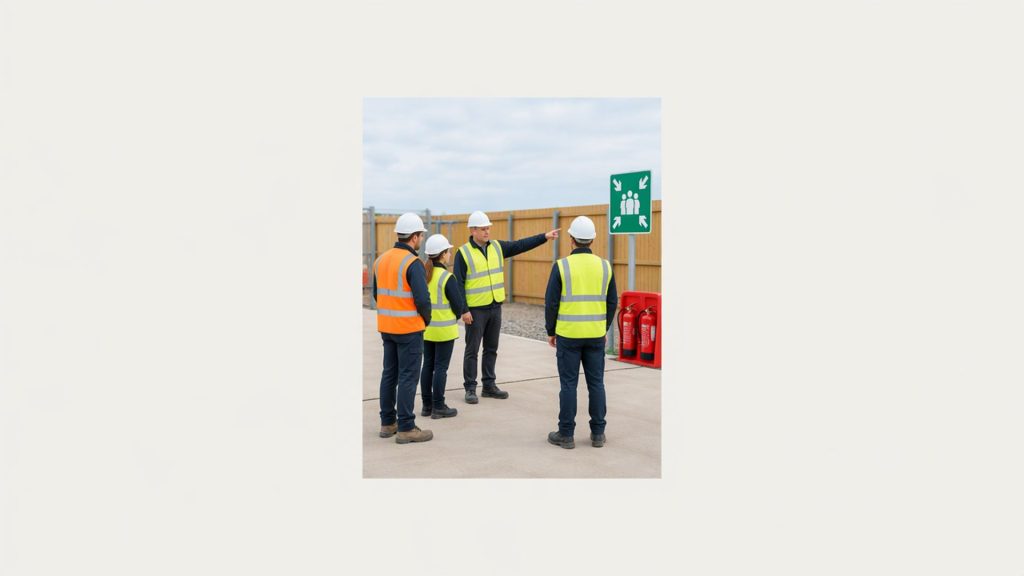
- Pay full attention at your site induction. You will learn where the exits, assembly point and first aid kit are, the site rules and the specific risks on that job.
- Read and follow the RAMS (risk assessment and method statement). If something isn’t clear, ask before you start, not afterwards.
- Wear the right PPE: hard hat, hi-vis, safety boots, gloves, eye protection and, where needed, hearing protection or a mask. It must fit properly and be in good condition.
- Only use equipment you are trained and authorised to use. Never climb an uninspected scaffold or operate plant you don’t know.
- Keep your area tidy. Good housekeeping cuts slips and trips dramatically.
- Report hazards and incidents straight away to your supervisor, including near misses.
- Stop if it isn’t safe. You are entitled to stop work that puts you in serious and imminent danger.
What employers must do
For employers and site managers, construction site safety starts with planning. In short, you need to:
- assess the risks and apply controls in line with the hierarchy of control: eliminate the hazard, reduce it, and only then rely on PPE;
- provide adequate information, instruction, training and supervision that every worker can genuinely understand;
- supply necessary PPE free of charge (since 2022 this also covers most “limb (b)” workers, not just employees);
- provide welfare facilities, drinking water and rest areas as required by CDM 2015;
- report serious accidents and certain dangerous occurrences under RIDDOR.
One point that is often overlooked: many people on UK sites don’t speak English as their first language. An induction that isn’t fully understood doesn’t do its job. Bilingual training and simple comprehension checks are an easy, effective win for any contractor.
CSCS cards and other site requirements
Most UK sites will ask for a CSCS card, which shows you hold the right qualifications and have passed the relevant health, safety and environment test for your role. Rafidin Education does not issue CSCS cards or deliver the CITB test; check the official CSCS website and citb.co.uk for the current process. Our online safety courses, however, help you understand the essentials before your test and your first day on site.
How Rafidin Education helps
Our Working Safely course explains, in plain language, how to spot hazards, how risk assessments work and what your responsibilities are at work. You can build on it with Fire Marshal, Asbestos Awareness and Health & Safety Essentials, all available in our Health & Safety category. To understand the fire marshal role in more depth, read Fire marshal duties in the UK.
- CPD-accredited courses that employers recognise.
- Bilingual content in English and Romanian.
- Online and self-paced, on your phone or laptop.
- Certificate available as soon as you finish.
- 1:1 consultancy for your career in the UK.
For employers: we train whole teams through our B2B packages, with online access for every worker and content in English and Romanian, ideal for mixed crews on site. Get in touch and we will put together a training plan that fits your business.
Working safely doesn’t mean working slowly; it means getting home in one piece every evening. Start the Working Safely course today or browse all Rafidin Education courses.
Frequently asked questions
What is the biggest risk on a UK construction site?
According to HSE, falls from height are the leading cause of fatal injuries in construction, followed by being struck by moving vehicles and falling objects.
Who pays for PPE on a building site?
Your employer must provide the PPE you need free of charge. Since 2022 this duty also covers most limb (b) workers. Check hse.gov.uk for guidance on your specific situation.
Does the Working Safely course give me a CSCS card?
No. The course gives you essential knowledge and a CPD certificate, but a CSCS card is applied for separately through the official CSCS scheme, which usually includes the CITB health, safety and environment test.