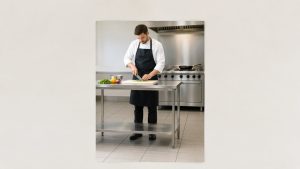


These commercial kitchen safety tips for staff are about the habits you repeat on every shift: how you deal with a spill, how you carry a knife, how you move a hot pan. In a busy UK kitchen, a few seconds of rushing can lead to a slip, a deep cut or a burn that keeps you off work for days.
Whether you are a chef, commis, kitchen porter or front-of-house team member, or you manage a restaurant, pub or hotel kitchen, this guide covers the three big hazards (slips, cuts and burns), what you can do about them and what employers are expected to do.
Why kitchen safety matters in UK hospitality
The Health and Safety Executive (HSE) lists the main causes of accidents and ill health in catering as slips, trips and falls; manual handling; contact with hot surfaces and harmful substances; dermatitis; and cuts from knives. HSE also states that slips and trips remain the single most common cause of major injury in UK workplaces, with kitchen assistants, chefs and waiting staff most affected.
The good news is that most of these accidents are preventable with simple routines the whole team follows.
How to prevent slips and trips in a kitchen
According to HSE, most slips happen on wet or dirty floors, and spills from food or cooking are among the main causes in kitchens. On every shift:
- Clean spills straight away — oil, sauce or water. Don’t leave it until after service.
- Sign wet floors and keep people away until they are dry.
- Report leaks from sinks, dishwashers or fridges, and use a drip tray until they are fixed.
- Keep walkways clear of delivery boxes, bags and cables.
- Wear enclosed, slip-resistant shoes suitable for a kitchen.
- Use the right cleaning product and method — floors left wet during service, or with too much detergent, become slippery.
Knife safety: avoiding cuts
HSE notes that cuts usually affect the non-knife hand and fingers. The basics:
- Keep knives sharp. A blunt knife needs more force and is more likely to slip.
- Cut on a stable surface — a damp cloth under the chopping board stops it moving.
- Carry knives point down by your side and call ‘knife behind’ when passing colleagues.
- Never leave knives loose on worktops or hidden in a sink full of soapy water.
- Never try to catch a falling knife — step back.
- For deboning, HSE recommends a protective glove on the non-knife hand and a protective apron.
The same thinking applies to slicers and other bladed equipment: only use machines you have been trained on, and never clean them while they are switched on.
Preventing burns from hot oil, steam and surfaces
Contact with hot surfaces is one of the main causes of injury in catering. Protect yourself by:
- Using dry oven gloves or cloths — a damp cloth conducts heat straight to your hand.
- Turning pan handles inwards so nobody catches them.
- Opening lids and combi-oven doors with your face turned away — steam burns as badly as boiling water.
- Following the manufacturer’s instructions on fryers, especially when draining and changing oil, which HSE highlights as a difficult task.
- Never putting water on hot or burning oil.
If someone is burned, the NHS advises cooling the burn under cool or lukewarm running water for 20 minutes. Alert your shift first aider and get medical help for large or deep burns, or burns to the face or hands. For fire risks, read our guide to fire marshal duties in the UK.
What employers must do
Employers must assess the risk from slips and trips and take reasonable precautions. HSE says catering employers must, among other things, have a health and safety policy (written down if they employ five or more people), assess and control significant risks, set up emergency procedures, and inform and train their staff. The law does not expect every risk to be eliminated, but people must be protected ‘so far as is reasonably practicable’.
Where personal protective equipment is needed to control a risk, the employer should provide it free of charge. For more on legal duties, see our health and safety courses and our guide to employer duties for health and safety training.
A five-minute safety routine for every shift
- At the start of the shift, check floors, leaks and walkways.
- Check knives are sharp and stored properly.
- Know where the first aid kit, fire blanket and extinguishers are.
- During service, clean spills immediately and call out when you are carrying something hot or sharp.
- At the end of the shift, report any incident or near miss to your manager.
Kitchen safety goes hand in hand with Level 2 food hygiene, allergen training for restaurant staff and the wider training restaurant staff need in the UK.
How Rafidin Education helps
Rafidin Education offers CPD-accredited online courses that help you work safely and show employers you are ready:
- Working Safely — the foundations of workplace health and safety, including spotting and reporting hazards.
- Fire Marshal — for team members who will lead fire prevention and evacuation.
- Level 2 Food Hygiene and Fire Safety, in our Health & Safety category.
Benefits: CPD accreditation, content in English and Romanian, online study at your own pace (even between shifts), an instant certificate on completion and 1:1 consultancy if you want to plan your next career step.
For employers: if you run a restaurant, café or hotel, we can train your whole kitchen team through a B2B package, with training records for each employee and bilingual materials for international staff. Get in touch and we will suggest a plan that fits your team.
A safe kitchen is a calmer, more efficient kitchen. Start the Working Safely course today and make safety a habit, not just a poster on the wall.
Frequently asked questions
What is the most common accident in a commercial kitchen?
Slips and trips. HSE says they are the single most common cause of major injury in UK workplaces, and in kitchens they are mostly caused by wet or contaminated floors.
Does my employer have to provide safety shoes for kitchen work?
If the risk assessment shows protective equipment is needed, your employer should provide it free of charge. Ask your manager what the kitchen’s policy says and check official guidance on hse.gov.uk.
What should you do first if you burn yourself in a kitchen?
Cool the burn under cool or lukewarm running water for 20 minutes, alert the first aider and get medical help if the burn is large or deep. Then report the incident to your manager.